Many of us have heard that we need to walk a certain amount of steps per day to maintain or improve our health. 10,000 steps per day is commonly cited as being the “magic number” in order to bestow upon us these health benefits. There is certainly research out there, most of it observational, that does indeed correlate step count to impressive health outcomes, including decreased all-cause mortality risk (AKA not dying), as well as psychological improvements such as enhancements of mood and fewer depressive symptoms.
Let’s dive into the science of step count, and why it may or may not be an important ingredient in our wellness recipe.
Current evidence
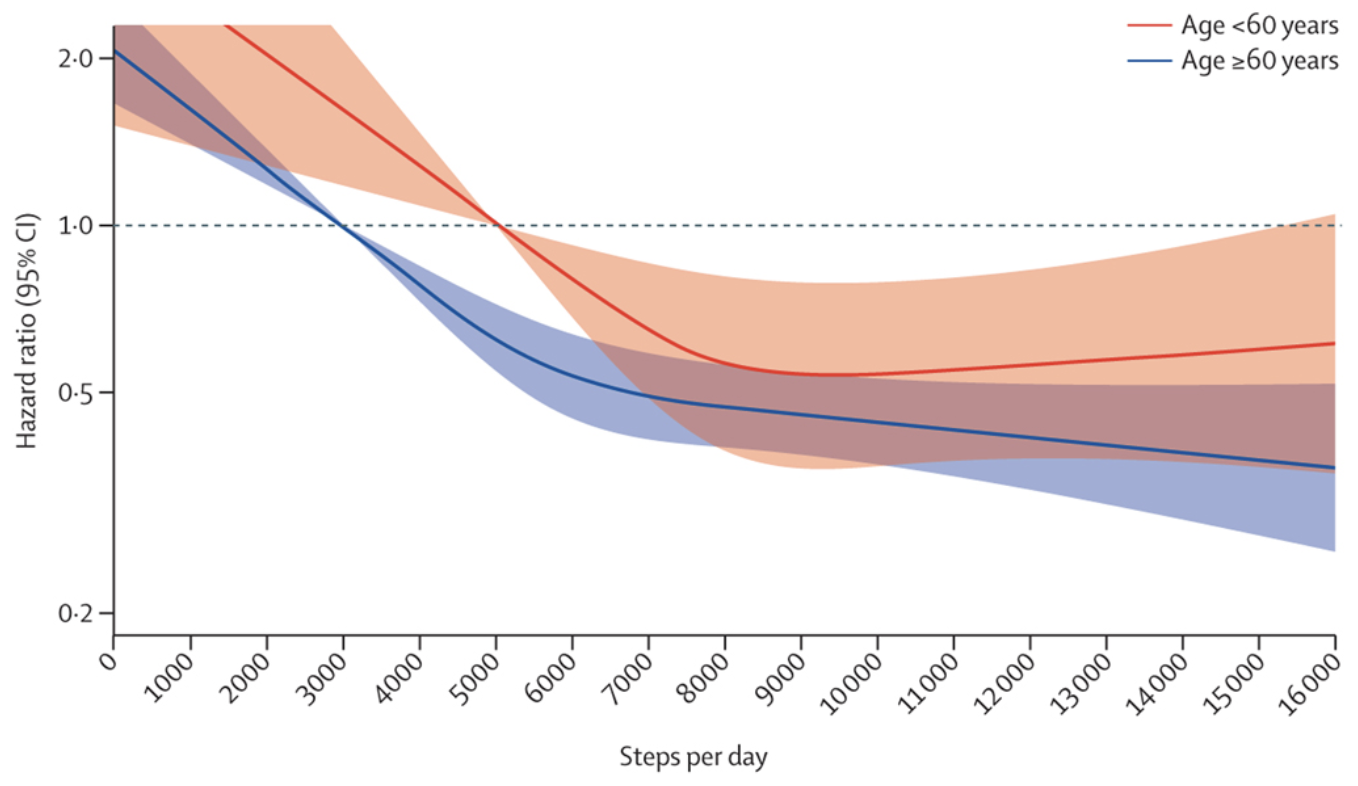
A meta-analysis was performed in 2022 that aggregated 15 studies spanning 20 years, including 47,471 adults (1). To sum it up, it found that more steps per day decreased all-cause mortality up to a certain point. A plateau did occur after a certain number of steps, and it did depend on age.
The risk of mortality progressively decreased with steps, and plateaued around 6-8,000 steps for adults OVER sixty years old, and around 8-10,000 steps for adults UNDER sixty years. Particularly for the younger adults, the mortality risk began to gradually climb back up after 10,000, meaning there can be diminishing returns.
A systematic review by Ding D, Nguyen B, Nau T et al. found similar results, observing that compared to 2,000 steps per day, 7,000 steps per day was associated with a significantly lower incidence of all-cause mortality, cardiovascular disease, cancer mortality, type II diabetes, dementia, and decreased falls risk (2).
This paper emphasized that the increasing steps from sedentary to moderately active (e.g. 2,000 - 7,000 steps) held the most benefits, and with further increasing step count from 7,000 to 10,000 only contributing to modest improvements in health outcomes.
A summary of these studies is that somewhere around 7 or 8,000 steps per day may be a much more achievable target than 10,000, and is typically just as beneficial (if not more beneficial) than getting 10,000.
What’s the secret sauce?
Why might higher step count contribute to these health benefits?
There are direct benefits from the steps as taking more steps will exercise the systems in the body that we need to navigate life: our muscles, our hearts, our lungs, our balance, and many more systems that integrate as we walk. Use it or lose it- without frequently exercising these systems, they will decline, leaving us at risk of debility. Walking will also help us avoid excessive weight gain, and it is well-known that obesity contributes significantly to mortality.

There are some less obvious reasons that step count may contribute to health, beyond these more obvious ones. For many, 8,000 steps on a treadmill may be less valuable than 8,000 steps in natural environments. Why might that be?
8,000 steps on the treadmill, perhaps for the sole purpose of getting steps in, would be a very different experience than 8,000 steps out and about. Being on a treadmill is typically more of a socially-isolated activity, and lacks variability and novelty. 8,000 steps in the real world holds other implications. It means you are engaging in activities! Connecting with friends, family, and community, or experiencing the beauty of nature. This can lift mood, and improve one’s sense of well-being and purpose.
This is not to discount treadmill work outs. They can be an excellent substitute, especially when the weather does not allow outdoor walking. Treadmills can be a great way to gain more data about performance, and excellent tools for improving cardiometabolic fitness. There are also groups and classes that incorporate treadmill training (e.g. Orange Theory) which does foster community and social connection.
Social isolation and loneliness are well-known predictors of mortality. Perhaps those of us taking 8,000+ steps a day are walking away from isolation and loneliness.

Why are there diminishing returns?
As described in the study, there is a plateau in benefits after a certain amount of steps, and even an increased risk of harm that happens gradually past 10,000 steps for older adults. Why might this be?
It may not be that the additional steps themselves are harmful, but rather what the individual could instead be doing with that time.
For example, if someone made a point to walk 15,000 steps every day, this would take up a lot of time. There are many other things that we have to do to maintain our health and well-being. These additional steps may be taking time away from other health-promoting activities, like strength-training, preparing nutritious meals, other meaningful hobbies, and having relaxing experiences with our loved ones. Or perhaps all of these steps don’t leave enough time to rest and recovery. Like most things in life, everything in moderation!

Future research
After investigating the science of step count, I certainly have more questions! As many of us know, correlation does not equal causation. Because most of the studies out there are observational, there is not convincing evidence that the steps themselves are contributing to the health benefits, or if there are other underlying variables at play.
Could people who are more likely to walk more also more likely to have other health-promoting behaviors or advantages? For example, a lack of access to a safe place to walk (e.g. living in a neighborhood without sidewalks, or in an area with high levels of crime) would likely decrease step count. Individuals living in these areas may also lack other resources that correlate with health including healthy food and high-quality health-care, which could just as easily explain poor health outcomes. It would be helpful and informative from a public health perspective to design studies that take these variables into account, which could guide community initiatives to improve step count safely for individuals lacking these resources.
Could psychological and social benefits that come indirectly from step count significantly drive the documented improvements in health?
It may be interesting to design a long-term study that investigates two groups of people who are followed over time- one group increasing their steps while alone on a treadmill, vs the other increasing their steps by engaging in various activities with social components. This information could be helpful in guiding individuals who wish to increase their step count, but are unsure of the difference in value relating to the environment in which the steps are taken.

Summary and additional tips
If you are not getting 10,000 steps every day, don’t fret! But it may be worth finding a way to track how many steps you are taking with a wearable device, and observing trends and patterns in your step count.

Research supports 6-8,000 steps per day is optimal for adults OVER 60, and 8-10,000 steps per day is optimal for adults UNDER 60. A sweet spot for everyone might be to aim towards 8,000 per day. There is no need to aim to get far more than 10,000, and in fact there may be diminishing returns if step count is overdone.
It is much more beneficial to increase step count if you are sedentary (e.g. increasing from 2 or 3,000 to 6 or 7,000), as compared to increasing step count by the same amount when you are already moderately active (e.g. from 5 or 6,000 to 9 or 10,000).
A great strategy to increase step count might be to sneak in one or two additional short walks each day that you might not otherwise take. A post-lunch walk of just 10 minutes will get another 1,000 steps in each day. In general, most people take about 100 steps per minute, so sneaking in short walks here and there will quickly boost a daily step count.
While there are many direct physiological benefits to walking, there may not be a need to get in more steps just for the sake of the steps. Get those steps with someone that you enjoy spending time with! Walk around at the farmer’s market to connect with the community. Walk on a beautiful nature trail. Not all steps are created equal- walk to live a textured life, not just to check a box.
While there are many direct physiological benefits to walking, there may not be a need to get in more steps just for the sake of the steps. Get those steps with someone that you enjoy spending time with! Walk around at the farmer’s market to connect with the community. Walk on a beautiful nature trail. Not all steps are created equal- walk to live a textured life, not just to check a box.
What questions do you have about step count? There is much room for future research!
Written by Jacob Tyson, DPT - Physical Therapist, Yoga Instructor
References:
Paluch AE, Bajpai S, Bassett DR, et al. Daily steps and all-cause mortality: a meta-analysis of 15 international cohorts. Lancet Public Health. 2022;7(3):e219-e228. doi:10.1016/S2468-2667(21)00302-9
Ding D, Nguyen B, Nau T, et al. Daily steps and health outcomes in adults: a systematic review and dose-response meta-analysis. Lancet Public Health. 2025;10(8):e668-e681. doi:10.1016/S2468-2667(25)00164-1